Being human together – Collective intelligence in the age of AI

Written by Tim Segaller
Published: 30 Jun 2026
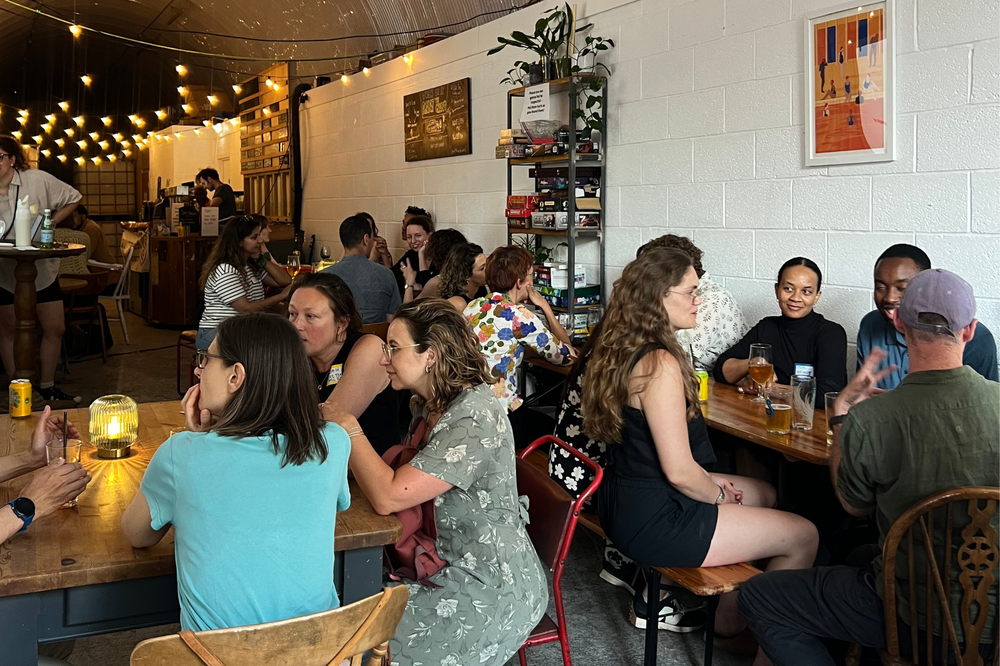
As AI becomes increasingly embedded in society and the workplace, Tim Segaller, On Purpose Coach, explores ways we can preserve and nurture human intelligence and collaboration. This article follows the interactive session Tim ran for our May ‘Drink, Think & Link’ community gathering. In the spirit of collective intelligence, it includes a selection of participants’ comments and insights.
Are you sitting comfortably? Then I’ll begin – with an ancient parable.
Long ago, a king received an oracle tablet that could answer any question. Its advice was so often correct that he came to trust it completely. He stopped visiting his people, listening to advisers, or investigating problems himself.
Years later, warnings came of an unusual storm. The king asked the tablet, “Will the storm endanger the capital?”. “No,” it replied. The storm passed offshore. Yet the tides it drove against the coast destroyed the kingdom’s neglected sea wall and flooded the harbour.
“The oracle was wrong,” said the king. “No,” replied an old sailor. “It answered your question. You forgot how to ask.”
Do you know this story, or its source? So, full disclosure, it was written by… AI! Its use here illustrates well my love-hate relationship with AI, which you may relate to. I couldn’t think of a real parable to allude to the potential dangers of over-reliance on AI. So I asked AI to find one. It couldn’t either and so, without even being prompted, it invented this one. The irony is rich.
I’ve been wowed by AI. It’s done some fabulous work for me – most notably, a brilliant analysis of a huge body of data relating to my coaching clients. Its capacity to process multiple data sources, and its working memory are extraordinary.
It’s undeniable that AI will have a major impact on individuals and society. It’s already happening. And much of that impact can be hugely positive – in developing new technologies for energy production, education, healthcare & medicine, food production, disaster prediction…and so on.
Realising this potential requires a new set of skills. AI literacy is rapidly becoming essential across sectors, including the impact space, and many organisations are still grappling with how to adopt these technologies productively and responsibly. The challenge isn't simply learning how to use AI tools; it's learning how to use them in ways that enhance, rather than erode, our own creativity, critical thinking and judgement.
However, the widespread adoption of AI brings concerns too. Most commonly, people fear for the impact on their jobs, for instance being 'replaced' by AI.
I want to explore other risks; and to imagine an ideal future where we mitigate these, and AI and human intelligence work in perfect harmony.
The threat to human intelligence and creativity
I’ve started to notice AI’s unhealthy creep into my life – chipping away at my confidence and willingness to think for myself. Like a siren song, it offers the false promise of endlessly increasing productivity and perfection. Chat GPT, having completed a task, will almost always suggest an improvement. Sometimes that’s helpful, but it can leave me feeling that ‘best’ is always just one step away. The road to hell is paved with such feelings.
Might we be on a slippery slope towards the abdication to AI of our creativity and problem solving – eroding our unique human wisdom, ingenuity and autonomy? Emerging evidence suggests that heavy AI use may be associated with reduced neural engagement and cognitive effort during complex tasks. We could end up trusting AI even when it contradicts our own judgement.
The loss here could be not only in our cognitive abilities, but more importantly the joy that comes from innovation and working through difficult problems. I have always enjoyed writing, even though it can be hard work (starting, especially). But once I gain momentum, it can flow and become deeply enjoyable. And it’s the very process of writing that allows me to understand fully what I’m writing about. But I’ve noticed I’m gradually writing less, as AI can (allegedly) do the job just as well. Maybe it can, but at what cost to my intelligence and creativity?
- “What does sitting with not knowing help you develop that going straight to AI might remove?”
- “I don't want my brain to wither and die!”
- “The essential life intelligence of which we are an expression is infinitely more intelligent than any human made tool or system.”
- “Optimisation and efficiency are not necessarily what bring us joy, connection and fulfilment.”
We risk forgetting and minimising our unique human difference. We don’t have only heads and cognitive processes. We have deeper wisdom and intelligence in our hearts and guts too. In my coaching work (an industry which AI is starting to invade!), my role isn’t just to understand cognitively what my clients are telling me, but to tune into what they really mean, and the complicated emotional forces at play. I pay attention to the ‘gut feelings’ of my intuition, and moments of inspiration – strong hunches about the next thing to ask that come to me seemingly from nowhere. Surely AI will never be able to do this?
The threat to collective intelligence and collaboration
If AI causes each of us to trust less in our own intelligence and capacities, it’s logical that we will also trust less in each other’s. As a result, we are likely to collaborate less. What can anyone else contribute if AI always has the ‘right’ answer?
A failure to work together to solve problems, and to tap into our collective human intelligence, would pose huge risks to society and the planet. Many of the biggest challenges facing us – like the climate crisis, or deepening inequality – persist not due to lack of knowledge, but to our failure to collaborate effectively at scale.
You probably know both intuitively and empirically how invaluable collaboration is in your personal and work lives. It’s particularly relevant in the impact space, where the best solutions to social problems can only be found by fully engaging with the people most affected. Perhaps the most important contribution the social impact sector can make is to create the conditions in which ‘disadvantaged’ people can belong fully in effective communities that become trusted sources of intelligence.
- “Do we hold an ability to sense into the collective field and to draw wisdom that AI could never replicate?”
- “AI cannot replace human communities or interactions or fully appreciate the human experience.”
- “Invest in teaching human intelligence – how to comfort someone, coaching – so we can offload the rote learning tasks to AI and have time for community.”
- “Look at an AI answer as a group and see what emerges.”
Imagining an ideal symbiosis of human and artificial intelligence
All these threats are very real and potentially damaging. So it’s vital we start to imagine a future in which people and organisations can integrate AI effectively, while also strengthening uniquely human capabilities. Drawing on the collective wisdom of On Purpose folks from the Drink, Think & Link event, here is a sketch of what that future could look like…
The most successful organisations will be those who bridge the two worlds of human and artificial intelligence – and who train their people to do the same.
Organisations will need to intentionally develop AI literacy and nourish uniquely human capabilities and skills. AI literacy is becoming a foundational skill – not because everyone needs to become a ‘star-prompter’ but because people need to understand when and how to use AI well, and where its limitations lie. At the same time, organisations will need to help people grow the skills that AI cannot easily replicate or imitate.
The most valuable professionals will be highly AI literate, and know what tasks to outsource to it (typically, data processing at a level beyond the brain’s functioning). They will know when to rely on their own judgement and systems/strategic thinking; and when it’s worth their or others’ time conducting a task, even if AI could do it faster, because the long-term value of deepening their understanding would exceed the short-term gain of time saved.
They will understand how to consult and collaborate with others, and will have high levels of interpersonal skills – emotional intelligence, relationship building, facilitation and communication. They will allow space for their own and others’ creativity and bold experimentation. They will know when to bring people together and get the best out of the collective, and when instead to empower individuals to work solo. They will be adept at sifting the golden nuggets of wisdom from the sand of our sometimes messy and fallible humanity.
- “We grow through working through things. How can we grow in collaboration with AI?”
- “Will more considered use of AI – in the areas where we choose to not struggle – free us up to be more present?”
- “We have agency in this. We have a choice.”
In the spirit of exercising your individual and collective human intelligence, I’ll finish with some questions:
- What version of this future do you imagine is the most likely, or desirable?
- Where might you best fit into it?
- What skills could you best focus on developing?
- Who could you collaborate with to continue these vital reflections?
About Tim Segaller
Tim is a Master Certified Coach & Mindfulness Trainer helping senior professionals navigate complexity, transition and leadership growth. Alongside work in organisations, he works in the community through Rising Minds, a social enterprise he co-founded that brings the transformative impact of coaching and mindfulness to people who otherwise wouldn’t be able to access them. For more information go to Tim's website and LinkedIn.
Written by Tim Segaller
Published: 30 Jun 2026