Writing for connection: a conversation with Mandemz Inner Thoughts

Written by Emma Kemp
Published: 08 Jan 2026
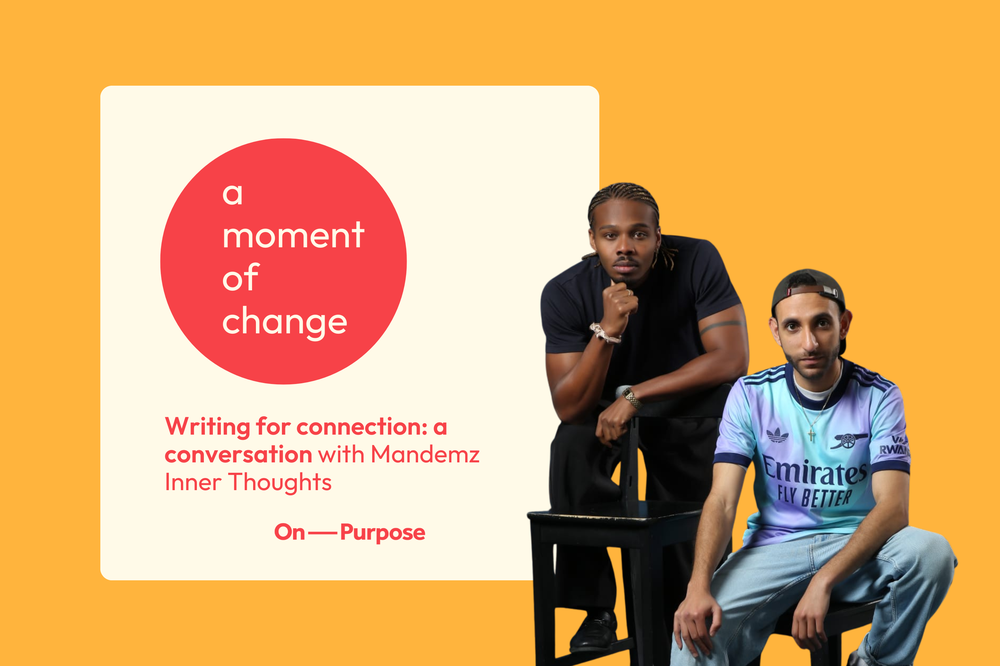
As part of the current A Moment of Change podcast series, On Purpose Associate Emma Kemp intended to speak to Angelo Mikhaeil and Nile Faure Bryan, co-founders of the men’s poetry group, Mandemz Inner Thoughts. Sadly, the podcast tech let them down, but not to be deterred, Emma continued with the interview. Below, she chats to Angelo about all things poetry, mental health and connection.
Could you share a bit about Mandemz Inner Thoughts, how you came to set it up, and what the community is like?
Nile and I, co-founders of the poetry group, have both been writing poetry to express our thoughts and feelings for years and years. While we were working together at Penguin Books, I put on an event at an all-boys school in Carshalton with poet Yomi Sode, artist Loyle Carner and Athian Akec, a former Youth MP. For this event we ran a poetry competition for the students, with the winner getting the chance to perform on stage in front of their peers. The winner, Lero, performed a piece called “Lero’s Inner Thoughts” – and this poem, and the day itself, inspired us to form the group.
That day, we saw that when you open up a space and give someone just a little nudge of encouragement, anyone and everyone wants to express themselves. Through poetry, we are able to give voice to what’s going on in our inner worlds, without having to directly talk about it. It can be easier to write a poem about our feelings, than to express them outright. That’s why I write. Most of the time, I can’t really catch my thoughts and feelings unless I put them on a page.
So, our community has been running for over a year now. One of us will read a poem, and then the rest of us would ask questions of the poet and each other. These discussions might last for more than 10 minutes, and could go on even longer if we didn’t have another dozen guys with something to say. Through this format we’ve been openly thinking about topics like belonging, faith, identity, current affairs and the news cycle, and of course all the beautiful things of life like family, home, and love. While it’s a space to express yourself we all know and feel that it is the discussion, the listening and the asking of questions, which is the real magic of our events.
It sounds like an amazing space! Given everything you’ve said, what do you think it is about writing that can provide a space for men to express vulnerability without fear of judgment?
A blank page is entirely your own. I always tell others, if you won’t write it down on a page, no one else can write it for you. If we can’t say it, then nobody else can. The word vulnerability suggests the revealing of weakness, but we don’t think about it in this way. A friend of mine named Eve, who runs an open mic night called Special Guest at the same venue, says: “When you step up to the microphone, you’re the hero”.
Someone isn’t a hero because they are invincible. Even Superman is vulnerable. What makes a hero is not being strong, it’s about standing up and fighting for something whether you’re strong or not. Being yourself out loud might mean people judge you, but what’s the alternative? We each have a voice, and we never know whether or not somebody might benefit from hearing what we have to say – even if it is only ourselves.
If your experiences are anything like mine, you sometimes find people can share very raw parts of themselves through their writing, in a way that can be both profound and affronting. What, if anything, has being part of a poetry group taught you about empathy?
Albert Camus said: “Dreams change from individual to individual, but the reality of the world is common to us all.” There’s always much more to what we share than it might seem on the surface. And while we all have differing dreams, different worldviews and beliefs, our common humanity binds us together. Being in a poetry group reveals that each of us are navigating this world in our own way, but the emotions we navigate and the questions we are asking ourselves are often the same. We may be looking at life from different perspectives, but we are all bound to this one reality: our humanity. Poetry, in my eyes, can help us see through the fog and witness and observe and better understand all that we share and all that we are.
What’s the most surprising thing you’ve learned about human connection through your experiences of the group?
To be honest, I’m not surprised with how our group has connected. I know that all of us regardless of status, class and gender are hungry to be seen, to be heard, and even to hear from others. We live in a lonely world. The paradox of our interconnected age is that it is so easy to feel disconnected. That’s why community spaces like ours really matter. What has surprised me most, I guess, is that even beyond events, community members are actively engaging in what we stand for: writing poetry, performing spoken word at church, and one of us has even harnessed the creative energy from the group to complete a manuscript for their first novel!
What’s a stereotype about masculinity that you think writing can help dismantle?
Before we are men, we are human. This means that the whole spectrum of human emotion is a palette we can use to express ourselves. Yes, there is value in stoicism, the apparent default philosophy of many of us, but there is also value in embracing the breadth of emotions that each of us feel. Our philosophy of life does not need to end at stoicism. Stoicism can be a foundation for something more life-affirming, pro-active and appreciative of life, and one that acknowledges the fact that we are all too human. Men in particular may feel that they should struggle in silence but this doesn’t have to be the case. It is not the only way. And, most importantly, any man, woman, or person, doesn’t have to find the way by themselves – we can do that together, through community.
What about your personal writing journey; how has writing woven itself into it? And how has this act of self-expression shaped you?
I always say that literature has saved me. It has shown me who I am, who I could be, and who I want to be. My own writing was inspired by the work of others – I wanted to emulate those poets, storytellers, philosophers, who helped to shine a light on what is true about the world and our place within it.
Writing has been an exploration of both the internal and external worlds and on this journey I’ve been developing my ideas and using the page to catch and capture my thoughts, rather than letting them slip away.
I’ve been thinking about how self-expression is a vital component to self-determination – someone once said something like “you have to tell the world who you are, otherwise, the world will tell you who you are.” By writing, whether poetry, prose, or in my journal, I’ve been telling myself who I am, what I believe in, and what I stand for, and having it written down has somehow helped me to embody these thoughts.
Without writing, I don’t really know who I’d be.
Whose writing has most inspired you and which poets would you recommend?
It’s impossible not to burst into a list here. Inspiration is everywhere: contemporaries such as Derek Owusu, Yomi Sode, Ashley-Hickson-Lovence, Caleb Femi, Maureen Onwuali, Malika Booker, have created work that has been illuminating for me. Their writing and/or poetry is imminent and urgent, composed and elegant as well as being sharp and potent. They have been painting vivid and vital stories of modern Britain. J.R.R. Tolkien and Ursula Le Guin, with poetic prose that will always spark my imagination, are heroes of mine. Their ability as storytellers still astonishes me. Recently, I’ve been loving haikus, ancient Japanese poetry; the way in which poets like Basho capture universal ideas in tiny snapshot moments of life can take my breath away.
The title of our podcast series is Creativity in Action. Do you see writing as something that can mobilise people into action?
Of course. It’s true that actions speak louder than words, but words can inspire action. What’s crazy is that in our pockets we carry an infinity of words: on our phones there are millions of websites, of voices, of marketing-slogans and headlines. It’s a lot to comprehend all at once. It’s confusing and paralyzing. What can it all mean? Through writing we can create a discourse that can help us to create our own principles, values, and beliefs. Whether alone or with others, having this gives us a guiding star that can help us to move and act in accordance with our own ideas and not the ones from outside ourselves that might make us feel small and powerless.
What’s the most hopeful thing you think poetry has to say to us?
Sigmund Freud said “Wherever I go, I find a poet has been there before me.” I’ve seen it too – whatever you’ve felt, or thought, or are going through, someone has written about it somehow, some way, in some point in time. They have given words to feelings and ideas already, words that can help you to understand yourself and others and can help you on your own journey through life. It is affirming to know how universal our experiences are, how connected we all are, and I believe words are the thread that binds us. You just gotta listen up.
***
About the authors:
Emma Kemp
Emma completed the Associate Programme in September 2025. She is a published poet (Google her!) and founder of Coventry Stanza, the poetry group which ran from 2019-2024.
Angelo Mikhaeil
Angelo has spent the past four years working on the social impact team at Penguin Books, helping the Lit in Colour campaign to support schools to teach more books by authors of colour in English class. Having now left the company, he’s thinking about how community organisations can invigorate the arts, education and arts education. You can follow him @yo_angiemk on instagram, and get involved with Mandemz Inner Thoughts by following our page @mandemzinnerthoughts.
***
Listen and subscribe to A Moment of Change on Spotify, iTunes, Acast, Google Podcasts or wherever you get your podcasts!
Written by Emma Kemp
Published: 08 Jan 2026